“Good communication is the bridge between confusion and clarity.” Nat Turner’s words ring especially true in animal health as the linchpin in effective delivery of care. Our words really matter. They shape expectations, influence behaviour and, ultimately, can affect care decisions. That is why the recent renaming of artificial intelligence (AI) as “Super Intelligence” (SI) in the US is important for those of us working in the multi-stakeholder field of animal health.
In September 2026, President Trump issued an Executive Order (EO) directing the US executive branch to replace the terms “Artificial Intelligence” and “AI” with “Super Intelligence” and “SI”. The White House argued that the new name better reflects the technology's “promise, potential, and rapidly advancing capabilities”. Major technology companies subsequently participated in a White House Accord on Super Intelligence, and the terminology has begun appearing in some industry and government initiatives. But why does this matter for animals?

What’s in a name?
A word is just a word, but when used as a name it attributes meaning. Super intelligence already has a technical meaning in AI science. Google DeepMind, for example, recently described artificial general superintelligence as a system that is “more intelligent and cognitively capable than large organisations of humans”. That is a theoretical future capability, not an accurate generic description of today's AI systems. Calling current AI “super intelligence” therefore risks quietly converting an aspiration into an assumption.
And the word super carries another connotation: superior. Superior to the comparator of human intelligence. This subtext becomes particularly problematic in animal health and veterinary medicine, which is already prone to automation bias (the tendency to believe the machine over the human), imposter syndrome and self-doubt. As words drive attitude, behaviour and - over time - culture, this risks further undermining the authority and credibility of professionals in the field.
Why we should not lose the word ‘artificial’
The word artificial is useful precisely because it maintains a cognitive boundary. An AI system can be exceptional at identifying patterns, generating language, analysing images and making remarkably sophisticated predictions. But fluent output is not synonymous with understanding, judgement, empathy or accountability.
Veterinary medicine is not simply an information-processing exercise. Clinical practice involves examining an animal, recognising subtle behavioural and contextual signals, understanding what an owner is telling us - and often what they are struggling to tell us - weighing uncertainty, discussing competing priorities and making decisions that incorporate welfare, ethics, feasibility and the human–animal bond.
The artificial/human distinction is therefore not something we should be rushing to erase. It reminds us what technology is (digital and apathetic), as well as what it is not (biological and feeling). Human healthcare researchers have raised similar concerns. A recent BMJ Innovations discussion warned that anthropomorphic generative AI can blur “the line between simulation and authentic human understanding”, potentially influencing professional judgement and the dynamics of patient care.
Experimental evidence supports the concern. Studies have found that making AI more human-like can increase perceived trustworthiness and users' willingness to rely upon it. One 2026 experiment found participants consistently rated an anthropomorphised LLM chatbot as more trustworthy than a neutral version. Names are an important part of our subconscious trust barometer.
‘Super’charging automation bias
This matters because inappropriate trust in automated systems is well evidenced. Automation bias describes our tendency to defer to automated recommendations even when they are wrong. Research found that correct AI recommendations improved clinicians' diagnostic performance, while incorrect recommendations substantially impaired it, creating a significant safety challenge for accuracy. It’s particularly important in busy veterinary clinics, excessive workload, task complexity, and limitations in time and cognitive resources within work-demanding settings contribute to bias.
That creates an important question for animal health. If we introduce a technology to veterinary professionals, farmers and pet owners as “super intelligence”, are we subtly telling them before they even open the software that its judgement is superior to theirs? Terminology alone may not create automation bias, but language can contribute to the formation of attitudes and reduce the appropriate level of scepticism and oversight in the outputs.
Trust should be earned, not inferred
Transparency is a huge issue in AI for animal health, and many tools currently entering the market have relatively limited independent evidence demonstrating performance across species, breeds, disease prevalence, settings and real-world populations. AI for animals also remains without the type of AI-specific pre-market regulatory and validation infrastructure required for human medical devices. That makes critical appraisal, transparency, independent validation, post-market monitoring and veterinary professional oversight more important, not less.
Calling an inadequately validated algorithm “super intelligence” risks reversing the logic. Instead of asking the technology to demonstrate why it deserves our trust, we start with the premise it already has elevated status. AI may well outperform veterinary professionals at specific tasks, and there is real value in that for improved access to care and outcomes for animals. But performance at one task is not synonymous with superior clinical intelligence, still less with superior human judgement.
Maintaining the mental gap
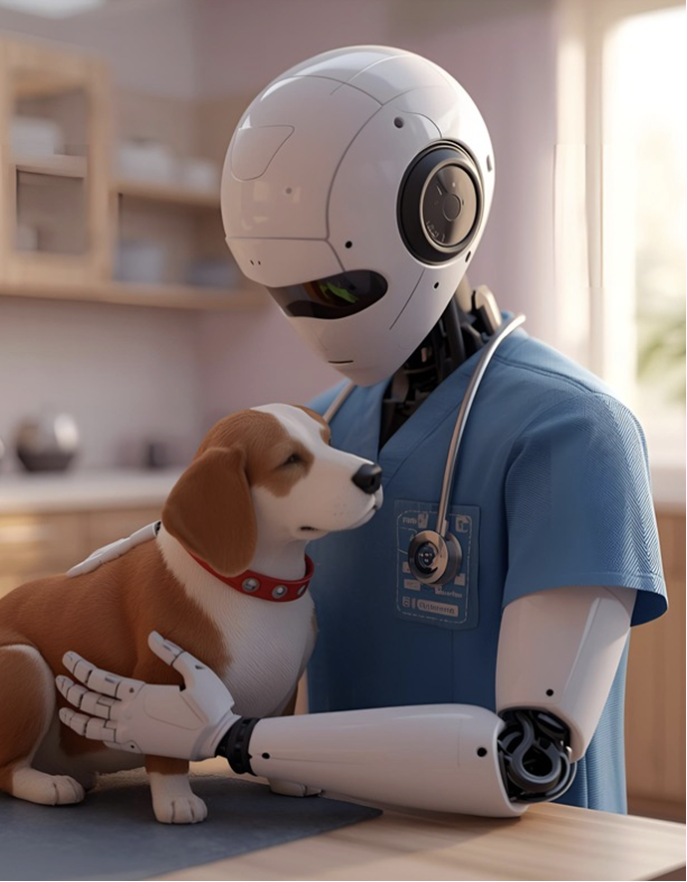
The term ‘artificial’ reminds us that technology does not think like we do. It may take the same data, but processes it in ways that are distinctly different to how our brain works. The emergent patterns may mimic, but do not replicate how human senses and nervous systems ingest, integrate, process and generate thoughts and outputs. Most importantly, artificial intelligence does not share the clinician's professional accountability and responsibility for the health and welfare outcomes for animals. However impressive its outputs may become, AI should not risk displacing the relationships between veterinary professionals, animals and the people who care for them.
Circling back to the EO; “The capabilities of today’s frontier systems do much more than imitate or automate discrete aspects of human intelligence. They increasingly amplify human ingenuity and unlock new forms of creativity”. Indeed, AI plus human physicians results in a higher level of trust in diagnosis and compliance from patients, emphasising the benefits of collaborative intelligence. The animal health industry should embrace the potential capabilities of powerful AI. But it will only truly be ‘super’ if it enables humans to excel at helping animals. This reframe maintains the human in the centre of collaborative superintelligence.
References
- The White House. Inaugurating the Era of Super Intelligence. Executive Order 14434, 29 September 2026.
- Google DeepMind. From AGI to ASI. June 12th 2026. https://deepmind.google/research/publications/239142/
- Oldemburgo de Mello V, Plaks J, Inzlicht M; The Effects of AI Anthropomorphism on Trust and Responsibility. Collabra: Psychology 5 January 2026; 12 (1): 161757. doi: https://doi.org/10.1525/collabra.161757
- Goddard K, Roudsari A, Wyatt JC. Automation bias: empirical results assessing influencing factors. International Journal of Medical Informatics. 2014;83:368–375.
- Kücking F, Busch DA, Przysucha M, Kutza JO, Hannemann N, Hüsers J, Babitsch B, Hübner U. Impact of AI recommendation correctness on diagnostic accuracy in clinical decision-making. Int J Med Inform. 2026 Mar 1;207:106223. doi: 10.1016/j.ijmedinf.2025.106223.
- Sujan M, Furniss D, Grundy K, Grundy H, Nelson D, Elliott M, White S, Habli I, Reynolds N. Human factors challenges for the safe use of artificial intelligence in patient care. BMJ Health Care Inform. 2019 Nov;26(1):e100081. doi: 10.1136/bmjhci-2019-100081.
- Abdelwanis M, Alarafati HK, Tammam MMS, Simsekler MCE, Exploring the risks of automation bias in healthcare artificial intelligence applications: A Bowtie analysis. Journal of Safety Science and Resilience, Volume 5, Issue 4, 2024, https://doi.org/10.1016/j.jnlssr.2024.06.001.